

22.04.2026
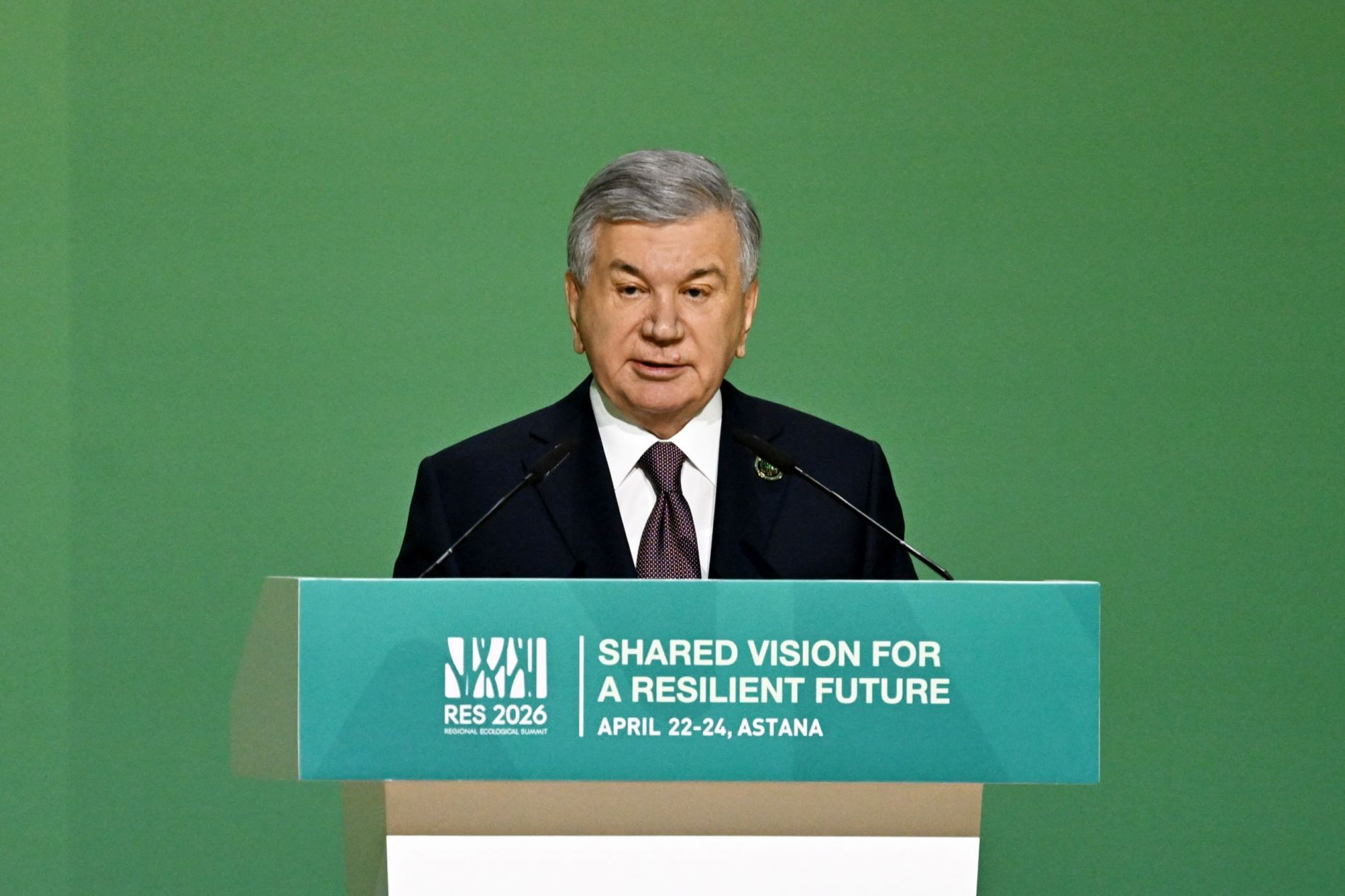
Your Excellency Kassym-Jomart Tokayev!
Esteemed heads of delegations!
Ladies and gentlemen!
At the outset, I would like to express my special gratitude to His Excellency Kassym-Jomart Tokayev, President of the Republic of Kazakhstan, for his initiative to host the Regional Ecological Summit, the high level of its organization, and the traditionally warm hospitality.
Uzbekistan fully supports the summit’s central theme “Shared Vision for a Resilient Future”, which highlights the deep interconnection of environmental challenges and the need to address them collectively.
Today’s meeting is a logical continuation of the dialogue initiated at the Samarkand Climate Forum last year.
It is encouraging to see the environmental diplomacy of Central Asian states reaching a new level of consistency and systematic approach.
Distinguished summit participants!
Today, environmental issues cannot be considered in isolation from global climate change.
The pace of global warming is accelerating, and temperature in Central Asia is rising twice as fast. Nearly a third of the region’s glaciers have been lost, precipitation patterns are becoming increasingly erratic, and water shortages are growing. Land degradation has already affected 80 million hectares.
The weakening of global environmental solidarity is a cause for deep concern. Declarations and calls to action are not backed by resources. Once again, the countries that have contributed the least to global climate change are left to face its consequences on their own.
We are convinced that international solidarity must be demonstrated, first and foremost, by ensuring that developing countries have timely, equitable, and unimpeded access to climate finance, advanced technologies, and innovations.
I am pleased to note that the Central Asian states have succeeded in elevating environmental protection to the level of a key priority in regional cooperation.
Examples of such partnerships include the Regional Program “Green Agenda” for Central Asia, the Regional Climate Change Adaptation Strategy, and the Regional Environmental Program for Sustainable Development.
An important contribution to this common cause will be the adoption at today’s forum the Declaration of “Environmental Solidarity of Central Asia”, as well as the Action Plan 2030, which will be implemented in close partnership with the UN agencies.
Esteemed colleagues!
Uzbekistan is implementing targeted and systematic measures to promote environmental sustainability.
As part of the “Green Space” project, around one billion trees and shrubs have been planted. More than two million hectares of afforestation have been established on the dried-up bed of the Aral Sea, and new “green belts” are being created. At our initiative, the UN General Assembly adopted a resolution on the “Decade of Action for Afforestation and Reforestation.”
Thanks to our large-scale water conservation efforts, we are saving 10 billion cubic meters of water annually. The share of renewable energy in our generation capacity has already reached 30 percent and will exceed 50 percent by the end of the decade. We have met our Paris Agreement commitments to reduce emissions by 35 percent ahead of schedule and have set a new goal of cutting them in half by 2035.
We are actively implementing waste-to-energy projects. This year, two new waste incineration plants will begin operations, with another nine to be launched over the next two years. Their commissioning will make it possible to process 5.5 million tons of waste annually, generate 2.2 billion kilowatt-hours of electricity, and reduce emissions by more than 1 million tons.
Dear heads of delegations!
In the face of climate and environmental challenges, I am convinced that Central Asia must act together and turn risks into new opportunities for growth. To this end, I would like to put forward a number of specific proposals.
First. Given the deteriorating air quality, I believe that establishing intergovernmental consortium “Clean Air of Central Asia” is an important step towards protecting the health of the region’s population. The consortium could serve as a joint operator of “green” financing aimed at modernizing industry and implementing emission control systems.
Second. I propose granting regional status to the Center for Combating Desertification, Drought Prevention, and Early Warning of Sand and Dust Storms, which operates under the Green University in Uzbekistan. Consolidating scientific capacity at the Center will enable the creation of a robust system for monitoring land degradation as well as salt and dust emissions.
Third. To accelerate the technological transition, I propose establishing a “Central Asian Green Trade Corridor”. The introduction of preferential customs regimes and the mutual recognition of certificates for eco-friendly products will enable us to modernize production more quickly and make our products competitive.
Fourth. The next step should be to create a unified Investment portfolio of climate projects in Central Asia. This will allow us to present a comprehensive strategy for the region’s development, rather than a collection of disparate initiatives, thereby increasing our partners’ interest in implementing them.
Fifth. The creation of a Unified Regional Atlas of Environmental Changes in Central Asia is of great importance for the future of our region. I am confident that it will provide a solid scientific and analytical foundation, clearly demonstrating the dynamics of desertification, land degradation, and the state of water resources in the region.
Sixth. To preserve biodiversity, we propose jointly developing a Red Book of Central Asia. The regional office of the International Union for Conservation of Nature in Tashkent could serve as the coordinator for this effort. The region’s Red Book will not merely be a list of endangered species; it will be an effective platform for our joint efforts in this area.
Seventh. Environmental education and the active involvement of young people are crucial for advancing the climate agenda and fostering an environmental culture. To this end, an Advisory Committee on the Environment was established during COP29 in Baku, with the participation of young people from our countries. I propose holding the World Youth Climate Forum in 2027 in Uzbekistan under the Committee's platform.
In an effort to advance the environmental agenda, Samarkand will host 8th Global Environment Facility Assembly from May 31 to June 5, and the World Forum on Water Conservation in late September.
I invite you to actively participate in these international forums. I am convinced that the outcomes will make a significant contribution to the implementation of effective initiatives aimed at the sustainable development of our countries and the entire region as a whole.
Distinguished participants of the summit!
Today’s environmental challenges are putting all our countries to the test.
The full implementation of the documents adopted today will enable us not only to adapt effectively to growing natural risks, but also to transform them into a powerful driver of technological innovation, economic growth, and social stability.
I am confident that, drawing on centuries-old traditions of good-neighborliness and demonstrating strong political will, we will transform Central Asia into a region of environmental well-being and sustainable development.
Thank you for your attention.


When using materials reference to www.president.uz is required
© 2026 Official web-site of the President of Uzbekistan
All rights reserved
Attention! If you find an error in the text, select it and press Ctrl + Enter to notify the administration
